
As AI and HPC chips generate more heat, liquid cooling is becoming increasingly important, especially for existing data centers. On June 16, 2026, Google introduced Brazos, a new approach to bringing liquid cooling to these facilities.
What Is Google Brazos?
Brazos is a new liquid cooling system from Google designed for existing air-cooled data centers.
As AI servers become more powerful, they generate more heat and need more effective
cooling. Liquid cooling can help handle this higher heat load, but adding a completely new cooling system to an existing data center can be difficult and expensive.
Brazos offers a different approach.
Instead of replacing the cooling system of an entire data center, Brazos is designed to provide liquid cooling at the rack level. This means operators can add liquid cooling to individual racks as needed, without having to rebuild the whole facility at once.
In simple terms, Brazos helps existing air-cooled data centers take the first step toward liquid cooling.
Google introduced Brazos as a modular solution for high-density AI and HPC computing, with the goal of making liquid cooling easier to deploy in existing facilities.
This raises an important question for the data center industry:
Why is it becoming so important to bring liquid cooling into existing data centers?
The Challenge: Existing Data Centers Were Not Built for Today’s AI Loads
According to Google, next-generation AI and HPC chips routinely exceed 1,000 W of Thermal Design Power (TDP).
At this level, traditional air cooling can become increasingly difficult to manage. For a newly built AI data center, liquid cooling can be incorporated into the facility from the beginning.
Existing facilities are different.
Converting an entire air-cooled data center to chilled-water cooling can require significant capital investment, construction work and time. This creates a practical question for operators:
How can high-density AI equipment be introduced without completely rebuilding the existing cooling infrastructure?
Brazos was developed around this challenge.
A Different Approach to Liquid Cooling
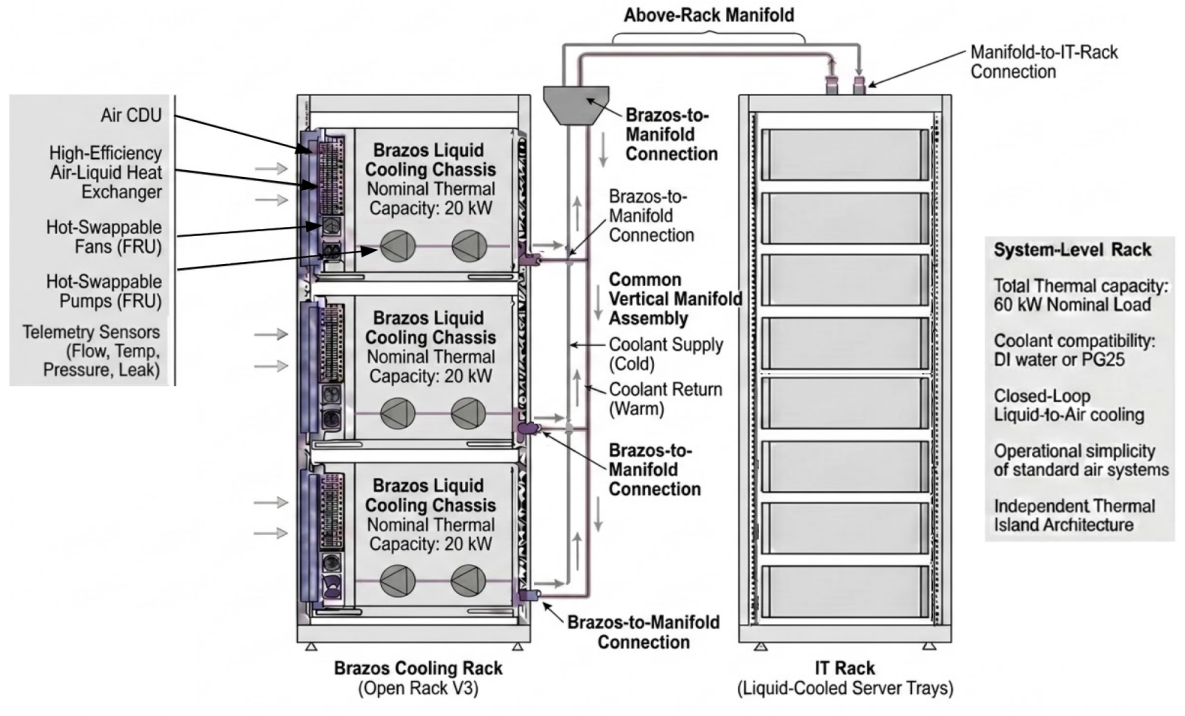
Rather than relying on a new facility-wide chilled-water loop, Brazos uses a self-contained liquid-to-air cooling architecture.
The system captures heat from liquid-cooled components and transfers it through liquid-to-air heat exchangers before rejecting the heat into the data center’s hot aisle.
Google describes the system as a modular solution for OCP ORv3 racks. Three cooling units work together to provide a 60 kW nominal thermal capacity per rack.
The system also integrates rack manifolds, leak detection and pressure relief features. It can operate using either deionized water or a 25% propylene glycol mixture.
More importantly, the architecture is designed for progressive deployment.
Instead of waiting for a complete facility upgrade, operators can introduce liquid cooling as their computing requirements grow.
This changes the deployment model from:Facility-wide cooling upgrade
to:Rack-by-rack liquid cooling deployment
Why Rack-Level Liquid Cooling Matters
The significance of Brazos goes beyond one particular cooling system.
It reflects a broader movement toward modular liquid cooling infrastructure.
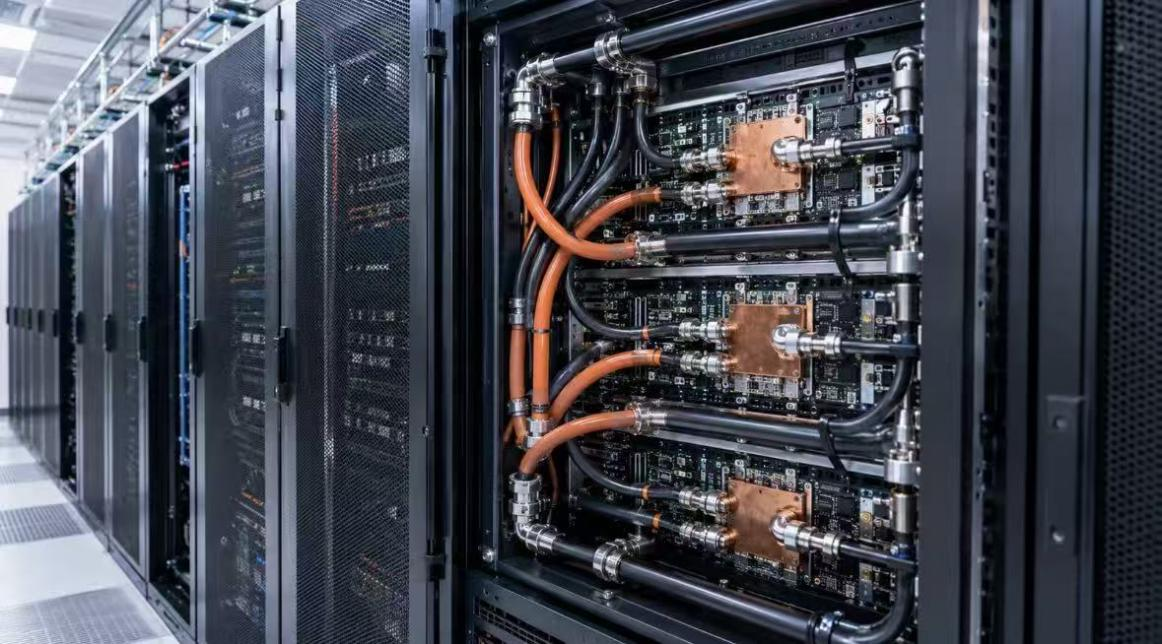
As liquid cooling moves closer to the rack, more components need to work together within a relatively compact space. Manifolds, hoses, valves, fittings and quick-disconnect couplings all become part of the overall cooling architecture.
The Open Compute Project’s current liquid cooling requirements specifically address rack manifolds and quick-disconnect couplings. Its guidance notes that rack manifolds distribute coolant between the CDU and IT equipment, while quick-disconnect couplings allow equipment or components to be separated from the cooling loop for servicing.
This makes serviceability an important consideration alongside cooling performance.
A component may be small compared with a CDU or heat exchanger, but it still needs to fit the system’s requirements for flow, pressure, sealing, material compatibility and maintenance.
Why Do Connections Matter in Liquid Cooling?
As liquid cooling moves closer to the server rack, valves, fittings and connectors are becoming increasingly important. They connect key parts of the cooling system, including CDUs, manifolds, piping and IT equipment.
The Open Compute Project (OCP) highlights quick-disconnect couplings as an important part of liquid cooling systems, especially when equipment needs to be disconnected for maintenance. Dripless designs can also help reduce coolant exposure during servicing.
When choosing liquid cooling components, several basic factors should be considered:
• Connection Type – Does it match the pipe or equipment?
• Flow & Pressure – Can it handle the system requirements?
• Material Compatibility – Is it suitable for the coolant?
• Leak Control – Can it provide reliable sealing?
• Maintenance – Is it easy to install, disconnect and service?
As liquid cooling becomes more modular, the right connection components can help make systems easier to install, maintain and expand.
Different applications, from CDU mainlines and manifolds to rack-level cooling, may therefore require different connection solutions.
Choosing the Right Liquid Cooling Components
As liquid cooling systems become more modular, selecting the right valves, fittings and connectors requires consideration of the complete system—not just the individual component.
Key factors may include:
• Pipe size and connection type
• Coolant and material compatibility
• Operating pressure and temperature
• Installation location and available space
• Disconnection and maintenance requirements
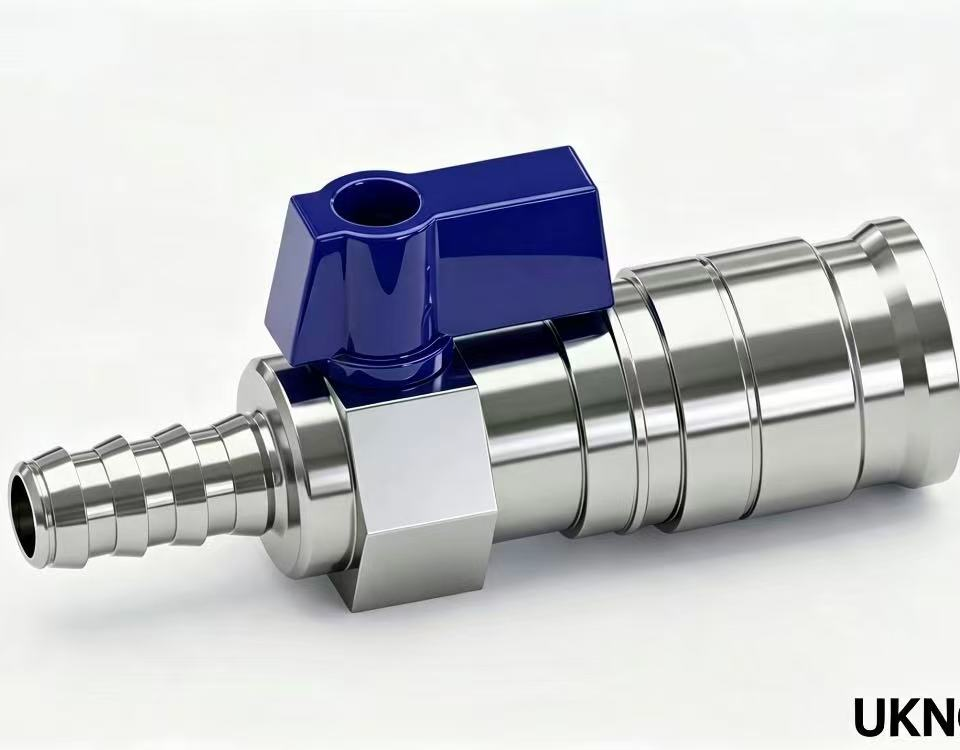
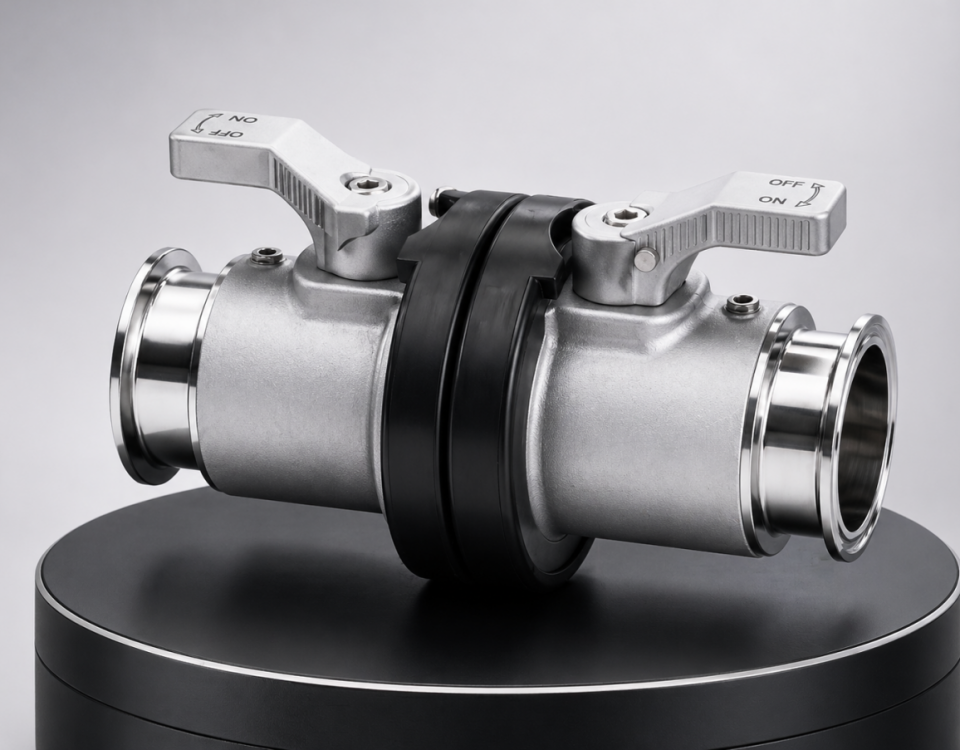
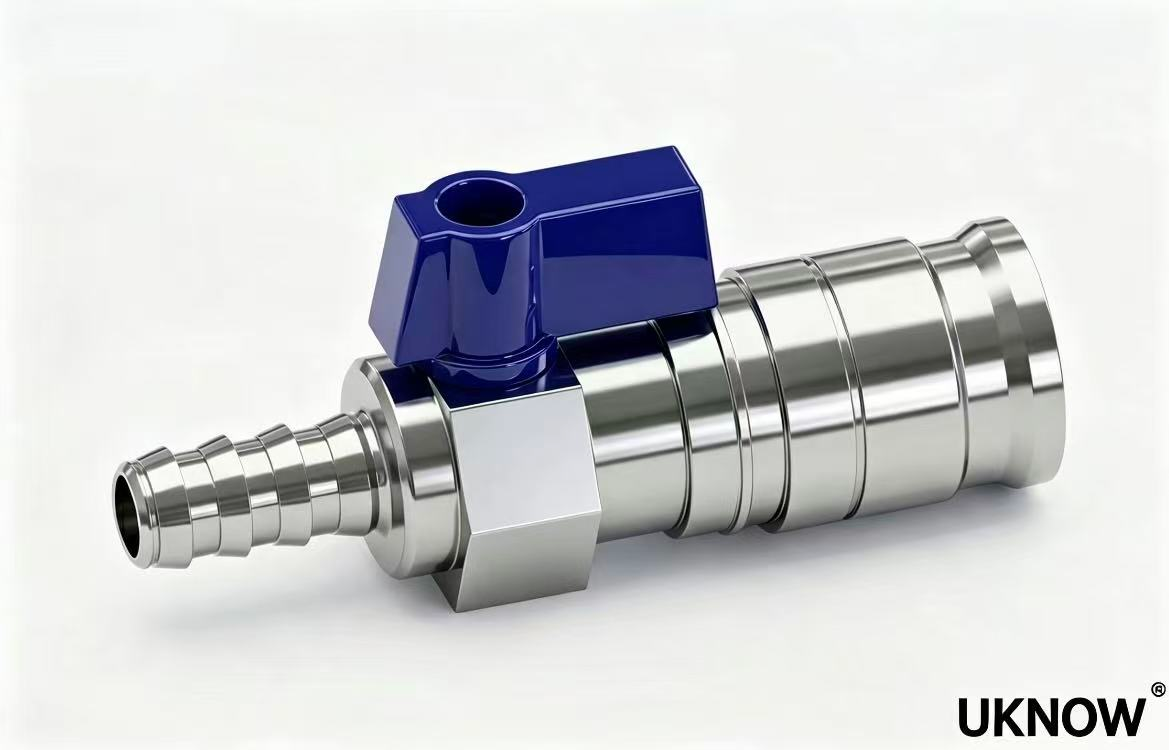
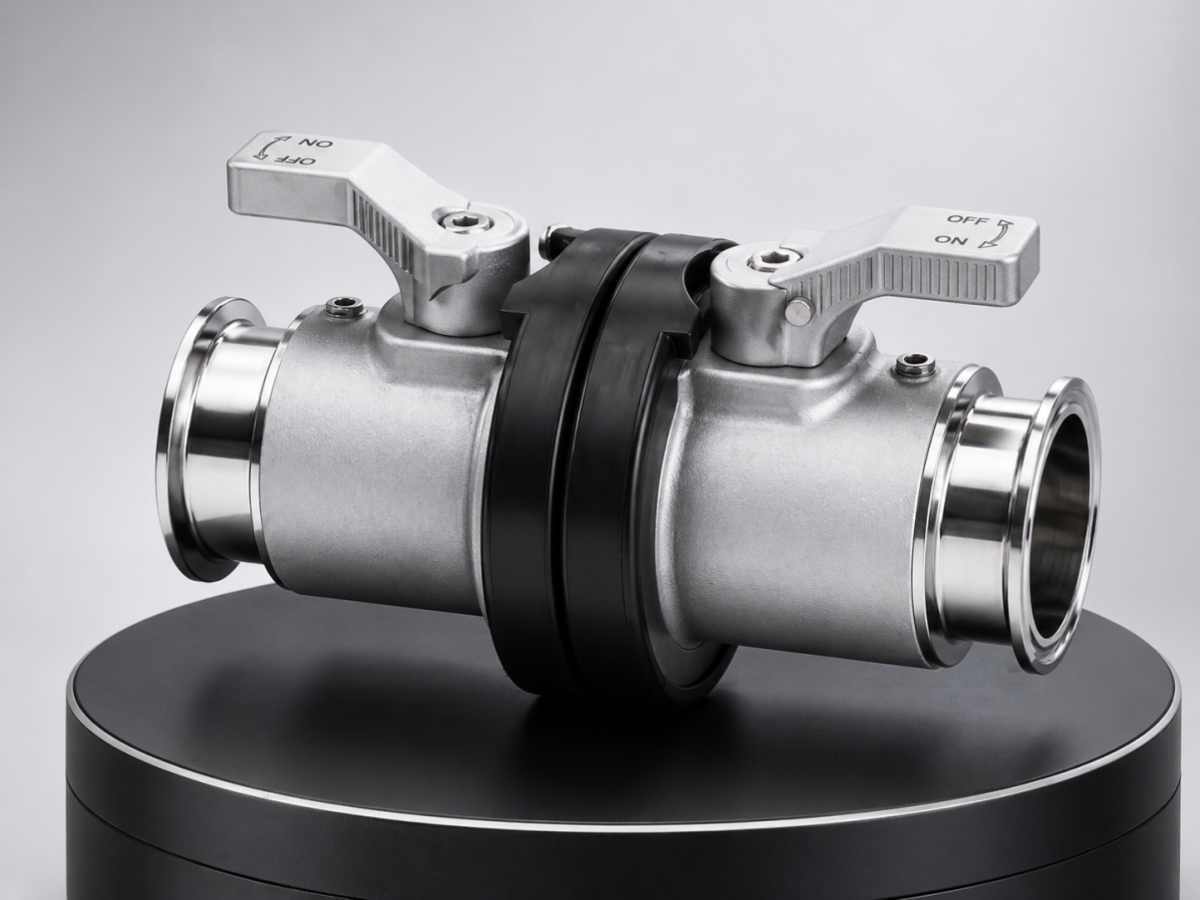
For applications such as CDU mainlines, manifold connections, rack-level liquid cooling and containerized systems, UKNOW offers stainless-steel liquid cooling valves, fittings and connector solutions, including FD83-compatible dry-break interlock valves with multiple termination configurations.
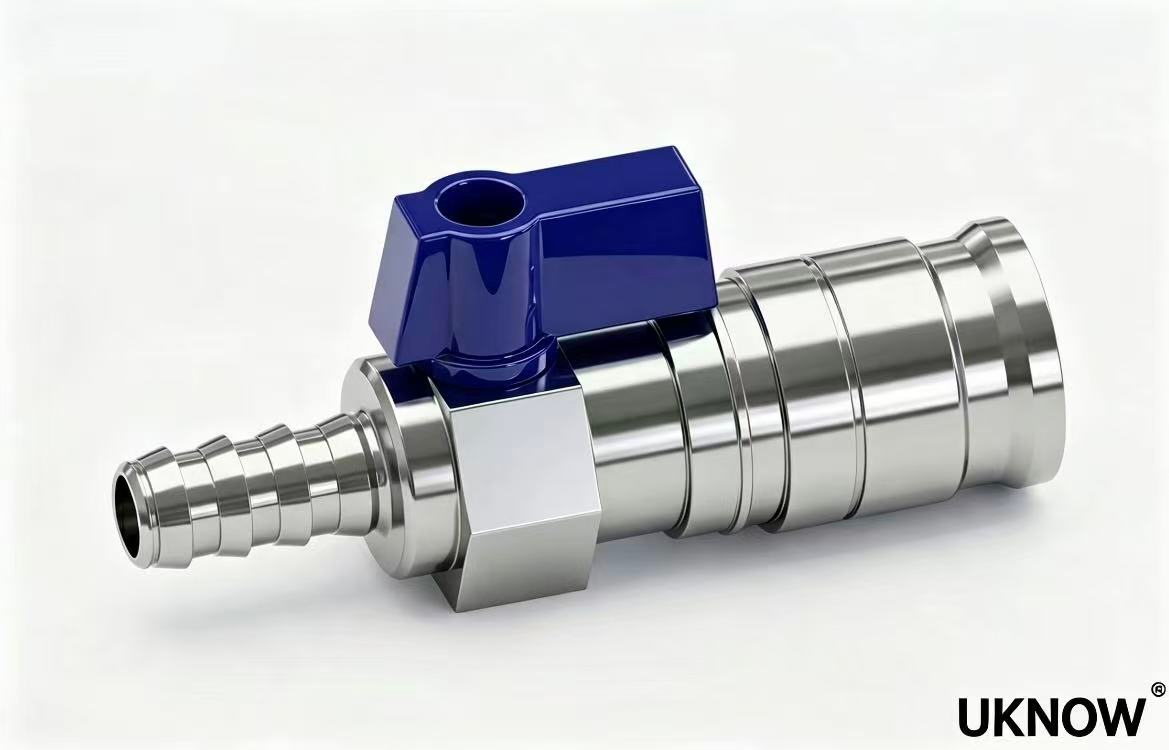
The products incorporate features such as mechanical interlocking and controlled disconnection, supporting applications where reliable connections and convenient servicing are important.
Every liquid cooling project has different requirements. If you are sourcing components for a CDU, manifold, rack-level cooling system or prefabricated piping assembly, you can share your pipe size, connection type, coolant, pressure, temperature or technical drawings with our team.
We can discuss suitable liquid cooling valves, fittings and connector solutions based on your application.
Request a Quote
Talk to Our Technical Team